
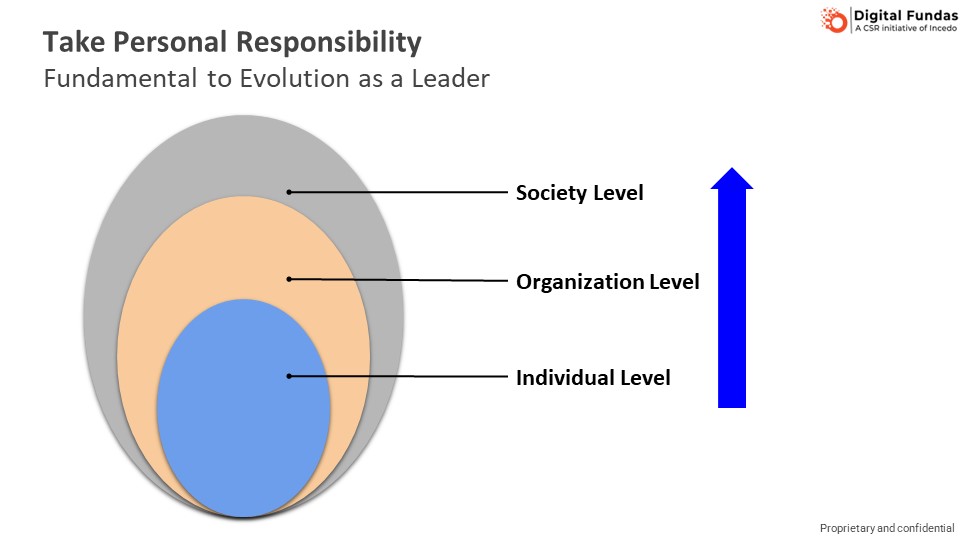
We are perennially disappointed with the companies we work in, whether it is with their policies, their politics or the company itself not recognizing our worth. Even in our personal lives, we have ready explanations for what other people are doing wrong and what they should do differently. However, we rarely look inside to see what we could do differently. This is a negative cycle. You change nothing and keep living in frustration and disappointment.
It is human nature to excuse or rationalize one’s own shortcomings while focusing on the obvious improvement needs of others. Our ego is the big culprit. It creates a sense of separateness and also a defensive shield. It makes us stand apart from the ‘system’, as opposed to being part of it. It makes us separate from other people, as opposed to being connected with them. It also creates a defensive shield that refuses to accept that we could be part of the problem. It leads to the ‘I am OK, you are not OK’ posture. All of this results in the rationalization that ‘if I did not create the problem or I am not part of it then it is not my responsibility to fix it’.
Even when we recognize the problem for what it is, there is often a sense of helplessness about any one individual’s ability to change the ‘system’. The ‘system’ often appears like an unshakable giant, impossible for an individual to move. Therefore, you end up rationalizing that it is pointless to make the effort!
The other challenge is inertia and fear of the unknown, which makes it difficult to move out of the status quo. We certainly crib about the status quo, but often find it difficult to rouse ourselves to action to change it. Inertia makes it difficult to leave the safe harbours of our daily existence. It requires additional effort and risk- taking to break away and set sail for the open seas. Fear of uncertain storms often overpowers the excitement of opportunities.
We can keep crying about the ‘system’. We can keep explaining how we are in the right or how little influence we have on the ‘system’. That is futile. Your frustrations and self-pity will make no difference. Any ‘system’ is nameless and faceless. You cannot hold it accountable. It cannot change on its own. Clearly, you cannot leave it to divine intervention! So, what choice do you have? If you are suffering, then it is in your interest to do something about the ‘system’. Given that the most control you have is over your own actions, it is best to start by taking personal responsibility. Your efforts will not be wasted. Any ‘system’ is made up of individuals. When enough individuals change, there comes a tipping point when the ‘system’ also starts changing.
We often feel that our influence on the ‘system’ is limited. The funny thing about influence is that if you act on what is in your zone of influence, that zone keeps expanding. This leads to growing confidence and broader impact. Conversely, if you keep focusing on what is not in your zone of influence, the boundaries keep pushing in, further limiting what you control. This only leads to further despair and frustration. Clearly, it is better to act and grow your zone of influence, as opposed to it continuing to push into you.
Finally, if you aspire to develop and be recognized as a leader, you have no option but to take broader ownership. Leadership is about going beyond self and creating broader impact. As you take personal responsibility for problems around you, the leader within you grows. We see numerous examples of this. Many leaders might have been spurred on their leadership journey by a personal hurt (e.g., Mahatma Gandhi, George Washington, Nelson Mandela) but they gained success because they took ownership of problems on behalf of others and created wide-ranging impact.
The start point is self-awareness. You must realize that there is no option but to take personal accountability. The only thing you can control is your actions. You can keep floating through life, frustrated and beaten by the system and the circumstances. On the other hand, you can stop, take personal responsibility, and do something about your circumstances. If you are not completely satisfied with a situation, ask yourself, ‘What can I do about it? If I can’t control it, how can I positively influence it?’
It is perhaps best to start small and focus on issues most in your control. They could be as simple as not wrongly overtaking on the roads, not throwing litter in public spaces, or not bribing the traffic cop when you can. At work, it could be giving your 100 percent to your job, reaching out to a colleague who needs help, reaching out to the company to point out a wrong policy or two and suggesting solutions. If you see problems in your industry or local community, then you could create a forum to get people together to discuss the matter and take common action on it. In personal life, it could be about being more empathetic and seeing issues from the other’s perspective. As you log in the small personal victories, your self- confidence grows, you gain more clarity on how to make broader change, and eventually your zone of influence grows.
There are, of course, limits to human action and what you can influence at a given point in time. Therefore, it is important to be able to understand and discriminate between what you can change and what you cannot at any point. However, the limits to human action and influence are a lot more than what we realize. Moreover, as I have said earlier, as we focus on action our zone of influence expands to include what earlier might not have been within our control.
The world around us is complex and has many problems. It is important that we move away from blaming others and take personal responsibility to tackle the problems that bother us. When we blame others, we give up our own power to change. When we take personal responsibility and action, we can create more positive change than we imagine.
I leave you with these beautiful words from Mahatma Gandhi, ‘You must be the change you want to see in the world’. If more of us could live this, our personal lives would improve immeasurably, and the world would be a more beautiful place to live in!