
When I was graduating from the MBA programme in IIM Lucknow in 1996, success for me was about getting the best job. And, how did I define ‘best job’? – one in the company that had the best brand, offered the best compensation, and where I saw my peer group joining or wanting to join. More than twenty years after my graduation, do I think those were wrong objectives? I don’t think they were wrong, but in hindsight they were not sufficient. Career is not a sprint; it is a multi-stage obstacle course. When you take a longer-term view of your career, additional perspectives start becoming important.
Many of my friends are at mid-career, in their forties and fifties, with at least twenty years of work experience under their belt and perhaps another twenty years to go. Most of them are very successful by any conventional yardstick – in senior positions in great companies, earning more money than anyone would ever need. However, I often sense emptiness and boredom in many of them. They are searching for something more. Some have even started talking about retirement in a few years’ time!! Why is that? Money and position are important. However, if you are just focused on them, you will be stuck in a ‘rat race’. Whatever you achieve will never be enough, you will always want more. This never-ending cycle can become very stressful.
For sustained happiness and fulfilment, you need to meet some deeper objectives in life.
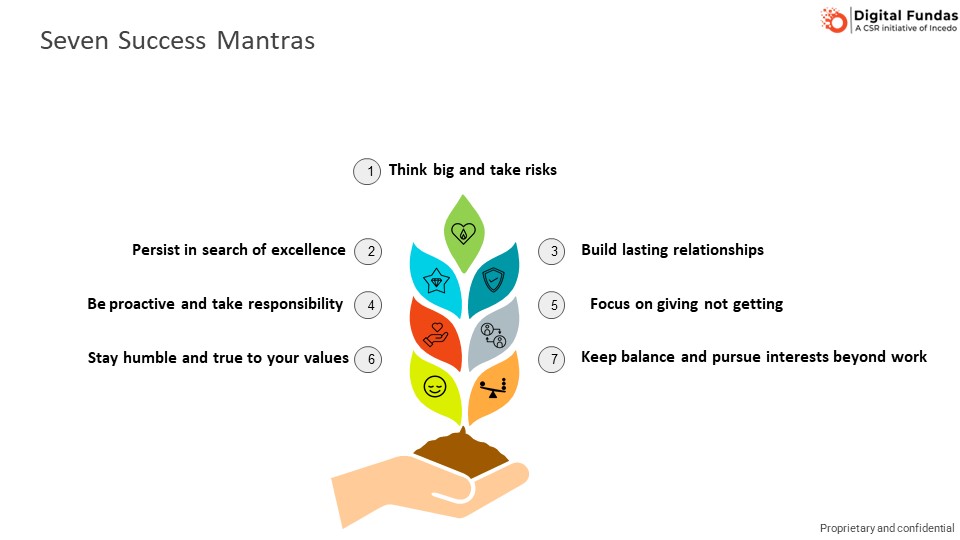
Nitin’s insight: My experience is that the downside of taking risks is often less harmful than what you fear and the upside a lot more rewarding than you imagine. Even if you fail, it will not be a catastrophe, and you will probably learn a lot from it. For me, leaving McKinsey early in my career and setting up my venture ActiveKarma was a big risk. The venture failed, but I was able to recover and get going again very quickly. Moreover, I grew tremendously from the experience. I thought I was a ‘hot shot’ consultant before I did the venture, but my lessons in building a business really came from my ActiveKarma experience. Whatever I achieved subsequently at McKinsey Knowledge Centre (McKC), Fidelity, Flipkart and now Incedo, I owe to those lessons. I am convinced that the risk I took with ActiveKarma and the experiences I had in running it have helped me do better as a manager and leader than I might have otherwise.
Nitin’s insight: I learnt this the hard way. Having started my career as a consultant I was used to rapid career progression. But when I did my venture, I was taken aback by the lack of progress and ended up shutting it down in two years. In hindsight, I realize that it takes much longer than two years to build anything meaningful and that I should probably have given my venture more time. That lesson has stood me in good stead subsequently in my career. I spent eight years at McKC and six in Fidelity. It is this perseverance that has helped me realize the visions and achieve the business impacts that would have appeared fanciful in the early part of the journey.
Nitin’s insight: When I joined McKinsey in 1996, one of the senior partners during our induction journey said that to succeed you either need to know something or know someone. At that time, I felt I was the ‘know something’ type and that success that came from knowing someone was a bit superficial. As I have gained more experience, I now realize better.
Nitin’s insight: Slowly, the change you started with your actions can come to a tipping point, when the ‘system’ also starts changing. Yes, there are limits to human action and you have to accept some situations. However, the power of individual action and influence is a lot more than we realize. So, do step up and take responsibility for the situations around you.
Nitin’s insight: I learnt this at the McKinsey Knowledge Centre (McKC). While I was consulting in McKinsey, the value addition for me was very tangible. However, during my early years as a manager at McKC, I began to feel very frustrated at the seeming lack of value addition for myself. At that time, I fortunately asked myself the question, ‘what value was I adding to others?’ I then started focusing on developing the people around me. As I did that something magical happened. My team members flowered; McKC grew tremendously, from a research back-office to an innovation hub; and as a result, I gained success as a leader.
Nitin’s insight: For me, my big anchor in life is my family. I am married, have three beautiful children and am part of a large joint family. They are an enormous source of strength in my life and keep me centred. In addition, I have many passions that I pursue. I am passionate about sports and play squash twice a week. I have been following Art of Living for almost twenty years now, and religiously attend yoga and meditation sessions every Sunday morning. Finally, I love to travel and take at least two vacations every year. These passions help rejuvenate me and keep my energy levels high.
For me, my big anchor in life is my family. I am married, have three beautiful children and am part of a large joint family. They are an enormous source of strength in my life and keep me centred. In addition, I have many passions that I pursue. I am passionate about sports and play squash twice a week. I have been following Art of Living for almost twenty years now, and religiously attend yoga and meditation sessions every Sunday morning. Finally, I love to travel and take at least two vacations every year. These passions help rejuvenate me and keep my energy levels high.